No Results Found
The page you requested could not be found. Try refining your search, or use the navigation above to locate the post.

 Estimated reading time: 2 minutes
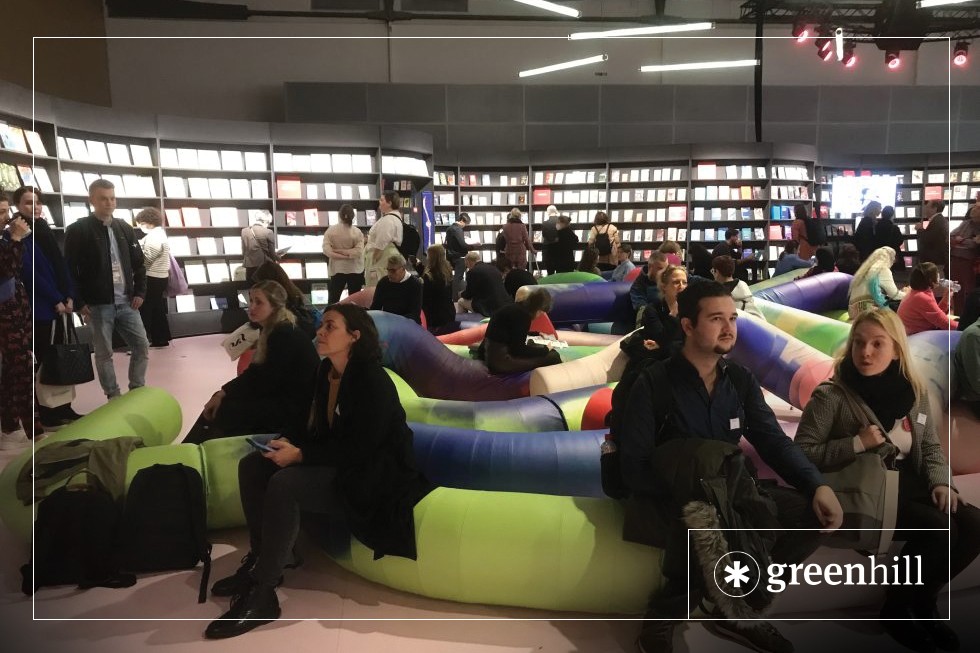
 It’s by far the world’s largest book fair and it’s back after the easing of the Covid pandemic. The event is still huge but only 50% of its normal size. Still there are 93,000 trade delegates and its suffice to say it’s a melting pot of nationalities, ideologies, creative talent and business acumen.
The first thing anyone coming to “Frankfurter Buchmesse” is the sheer size of this industry in terms of both cultural and intellectual importance and financial clout.
 Green Hill Director David and Production Manager Gina are here getting a select cohort of our authors in front of foreign publishing companies. The fair is the world’s premium rights market where the right to publish books in defined territories/languages are bought and sold. We are representing just 5 of our authors.
The world’s top-tier publishing professionals have energetically reconvened with force. There are experts in every area imaginable from metadata/findability, production automation, marketing, rights, writing, design and technology (including new audio book technologies).
One thing is for sure – there are very few self-publishing companies interacting in this space. We have not seen another Australian self-publishing company here. We wonder where they are.
We have been complimented on Green Hill’s book design prowess and the quality of content. This bodes well for Green Hill’s future (and our faithful and valued authors).
David and Gina from Frankfurt I Germany
The page you requested could not be found. Try refining your search, or use the navigation above to locate the post.


Estimated reading time: 2 minutes
STRATEGIST – “Do we need to talk about the book hierarchy?”
DESIGNER – “Yes, there’s a problem.”
STRATEGIST – “We need to advise the author about the issues. It won’t work in print will it?”
DESIGNER – “No. His editor seems a little inexperienced.”
Are the strategist and designer trying to make life difficult for the author and his editor? No, they are trying to produce a winning book.
Most first time authors are unaware of the complexities of making a winning book. The issue of hierarchy is all about how information is structured so that the reader has the best chance of absorbing and understanding the information.
 The chart at right shows how a business might be organised – how staff relate to each other and how the human resources are organised. Written information can be organised in the same manner. This is often expressed in a book Contents.

The Contents page – Edward Stratton-Smith’s complex hierarchy for his excellent book Traffic Offences.
But hierarchy usually runs deeper than just the chapters shown on a Contents page.
There can headings, subheadings, lists/bullet points, and breakouts/text in boxes and margins. A big issue is how ‘deep’ the information is organised and how ‘wide’. Often an author structures the information too deep, so deep the reader forgets what the context of the information being presented is, what the focus of the chapter is, and/or what the author’s lesson or argument is. Confusion is the result. An experienced editor will know what to do.
When book hierarchy is appropriate, good book design will follow.
The page you requested could not be found. Try refining your search, or use the navigation above to locate the post.
The page you requested could not be found. Try refining your search, or use the navigation above to locate the post.
Estimated reading time: 3 minutes
People judge a book by its cover and that includes the book’s title. A good name will be highly influential in helping your book succeed.
Its easy to compare a book cover to advertising. It certainly is critical to your book’s success. If the cover (including the book title) isn’t right then readership will suffer.
 A book title is a little like an advertisement headline, or a sign.
What’s wrong with this sign? Is the word “Koala” a proper noun/brand name or a common noun? The rendering in all-capitals makes it even more confusing. No wonder the Mexican Shop has gone out of business. Not only aren’t there many Mexicans in Australia but the thought of cooking those cute Koalas in a specialised oven is repulsive to 99.9% of Australia’s population. I’ve taken this to the extreme, but I’m sure most will get my point.
Authors need to think their book titles through.
Some simple suggestions include:
Having said all this if you have an Amazon book marketing strategy, then some of the advice above doesn’t apply.
Amazon for books (like websites) is driven by keywords. Keywords are more than “king”. They are also queen, prince and princess – they are everything! If you have an Amazon-first book marketing strategy then you’ll ideally have a book title that contains category relevant keywords. We can provide an Amazon strategy consultancy that will give your book real hope of being an Amazon book-marketing champion.
The page you requested could not be found. Try refining your search, or use the navigation above to locate the post.
The page you requested could not be found. Try refining your search, or use the navigation above to locate the post.