No Results Found
The page you requested could not be found. Try refining your search, or use the navigation above to locate the post.


 Estimated reading time: 9 minutes
Self-publishing and traditional publishing are two similar yet distinct avenues authors can use to get their writing out into the world. While both publishing solutions offer authors the opportunity to share their work, self-publishing and traditional publishing differ significantly in their approach and processes and both can be beneficial in different ways.
The appeal of self-publishing to authors is that they can maintain control over their book. It is up to the author to manage the whole process, from editing, book cover design, typesetting, printing, marketing, and distribution. The author is able to outsource the work to freelancers or an assisted self-publishing company to help them produce a more professional produce and assist them with a process they may not be familiar with. This is the difference between do-it-yourself self-publishing and assisted self-publishing. Self-published authors also typically maintain all the rights to their project and most of the royalties from the sales.
Some self-publishing endeavours can be nearly completely free for authors. This includes options such as KDP and Ingram Spark Publishing. However, if the author wants assistance with the production process, they will need to finance it themselves.
The start of a traditional publishing endeavour for most includes the author submitting their manuscript to the “slush-pile” in hopes of gaining a publishing deal. Often authors submit their manuscripts through a literary agent to up their chances of being accepted. Once accepted, the author often receives an advance payment from the publisher that is later taken out of future royalties. The publisher will then put the manuscript through the necessary processes needed to produce a book: editing, book cover design, interior design, and then to marketing, print, and distribution.
With traditional publishing, the author maintains little to no control over the production of their book. To elaborate, the publisher will take over aspects including the editing, design—even the book’s title—to make sure that the book is marketable and appeals to a wide audience. The author also receives a smaller royalty percentage on each sale than the publisher as they have to cover the production costs and turn a profit.
The lesser-know third option—hybrid publishing—is much like how it sounds. It is a hybrid model that sits somewhere between self-publishing and traditional publishing, combining elements of the two. With a hybrid publisher, the initial process will be very similar to traditional publishing, in that the author has to submit their manuscript for selection and, once approved, the hybrid publisher will undertake a variety of services such as editing, book cover design, interior typesetting, distribution, etc. The difference is that the author maintains more control over the process, like they would in self-publishing.
With any publishing endeavour, there is always financial risk involved. This is because no one can accurately predict how a book will act in the market—especially for new authors. Someone has to pay for the manuscript to go through the strenuous process of becoming a book, so who is it? First, you have to identify which type of publishing you’re considering:

While many DIY self-publishing platforms themselves offer free or relatively low-cost set-up, this do not mean that the production of the book is also free. Unless you are confident you can do everything by yourself, including editing, illustration, ISBN registration, book cover design, interior typesetting, marketing, and more, you will likely be paying for industry-trained professionals to help you with these tasks. This means that you will have to put in a lot and work and up-front payments while having no guarantee that your book will sell.
When employing the services of an assisted self-publisher, like Green Hill, you will need to pay for their services. This usually includes book cover design, interior typesetting, and ISBN registration. Some also offer editing, illustration, print, distribution, and marketing, though these might be extra to the initial package. The benefit of using an assisted self-publisher is that you can off-load much of the work compared to DIY publishing and instead be guided through the process. Be sure to do your research and find the best solution to you.
In hybrid publishing, both the author and the publisher are financially viable for the production of a book, including the editing, book cover design, interior typesetting, ISBN registration, illustration (if needed), print, distribution, and marketing. In turn, they both also receive royalty payouts; the author will usually get a higher royalty percentage per book than they would with traditional publishing.
With a traditional publishing model, the author doesn’t contribute financially to the production of the book once the publishing house takes over. The publishing houses receive their financial compensation through the sales of the book and receive a higher percentage of the profits than the author does. This means that, while the production of the book is free initially, authors are not given a high royalty for each sale.
There are a few factors to take into account when considering which publishing route is best for you, but some major ones to consider are:
Self-publishing can be done for free, but if you want to hire professionals you may be looking at paying a few thousand dollars. Traditional publishers don’t require any payment from their authors, but your manuscript has to be accepted, which can be a long and arduous process. Then, once your manuscript is selected and published, you may not see any profit return as the publisher, retailer, and wholesaler will take their cut first.
Timeline can be important for a number of reasons. Some wish to publish their book before a loved one passes, others need business publications by a certain date, and some want to publish strategically around major holidays like Christmas.
If you have a strict deadline, self-publishing is the route for you. With DIY self-publishing, you can do everything at your own pace, and the process is often still speedy with assisted self-publishing as long as nothing goes out of scope and there are no setbacks. Traditional publishers, however, can take anywhere from months to years to publish a book.
A major factor of choosing your publishing avenue is your intentions for publishing. Below are a few of the most common and which service they suit best:
The page you requested could not be found. Try refining your search, or use the navigation above to locate the post.
The page you requested could not be found. Try refining your search, or use the navigation above to locate the post.


Estimated reading time: 10 minutes
There are a few different kinds of printed books available for readers and one is the casebound book. What exactly is involved in the making of a casebound book and is there any benefit to it? Read through this post and find out.
Casebound, often referred to as hardcover, is a very common format for a book to be made in. How to identify a casebound book is by its cover, which will be hard and sturdy. This differs from the other common format, paperback (or softcover), as they have soft and flexible covers.
Some casebound books also come with dust jackets, which are made from a higher GSM paper than the interior pages and feature the same cover design as its paperback version. In instances like this, the casebound cover would have a more simplified design or be left almost blank and only have detail on the spine.
In traditional publishing, books are often first released in a casebound version before they transition over to paperback.
Firstly, the book blocks are created. This begins with printing, then moves to guillotining, and then binding. The binding style can differ but is usually limited to one of the standard processes: section sewn or glued. Once bound, cloth spines are added and the book blocks are complete.
Next, the cases are made. The process depends on the style of case (paper- or material-covered), as they require different steps and machines to complete. For paper-covered casebound books, the covers are first printed and cut to shape, then glued to and folded around the three pieces of board (front, spine, and back), before the book blocks are glued in place. For material-covered casebound books, a dedicated machine is used to attach and wrap cloth/imitation cloth around the three pieces of board (front, spine, and back) before they are glued to the book blocks.
Casebound books (either material- or paper-covered) can include the following extras:
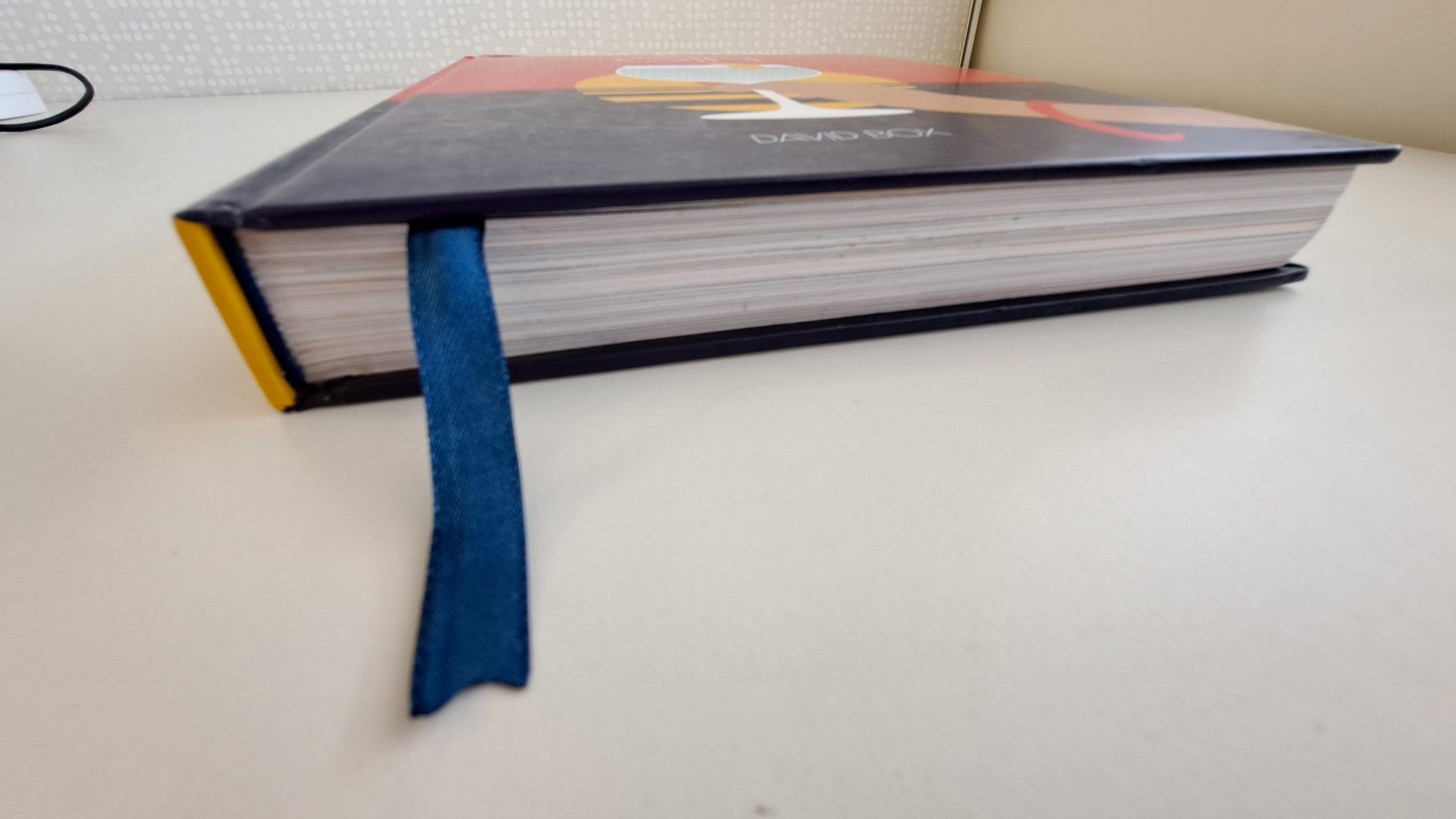
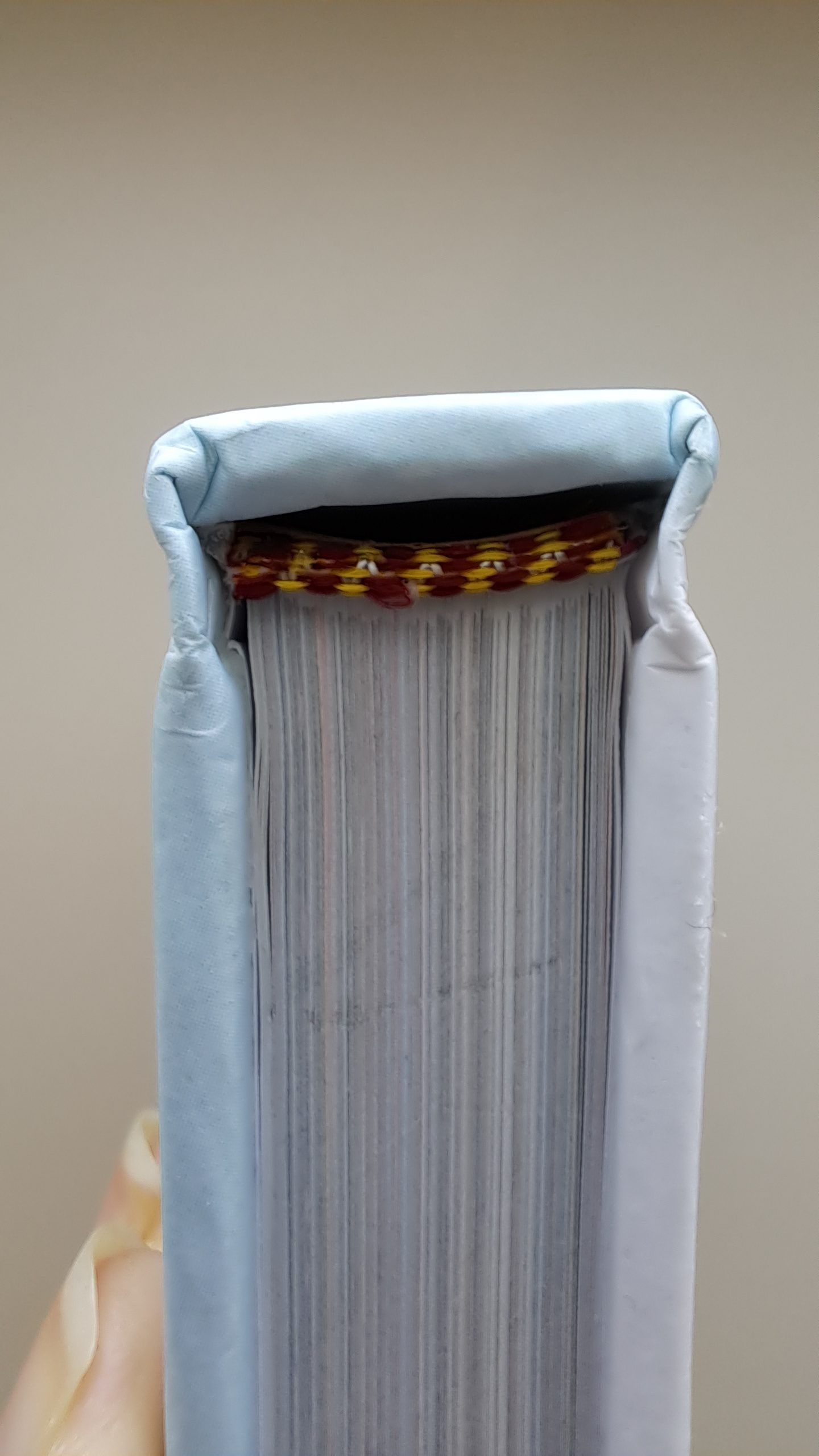
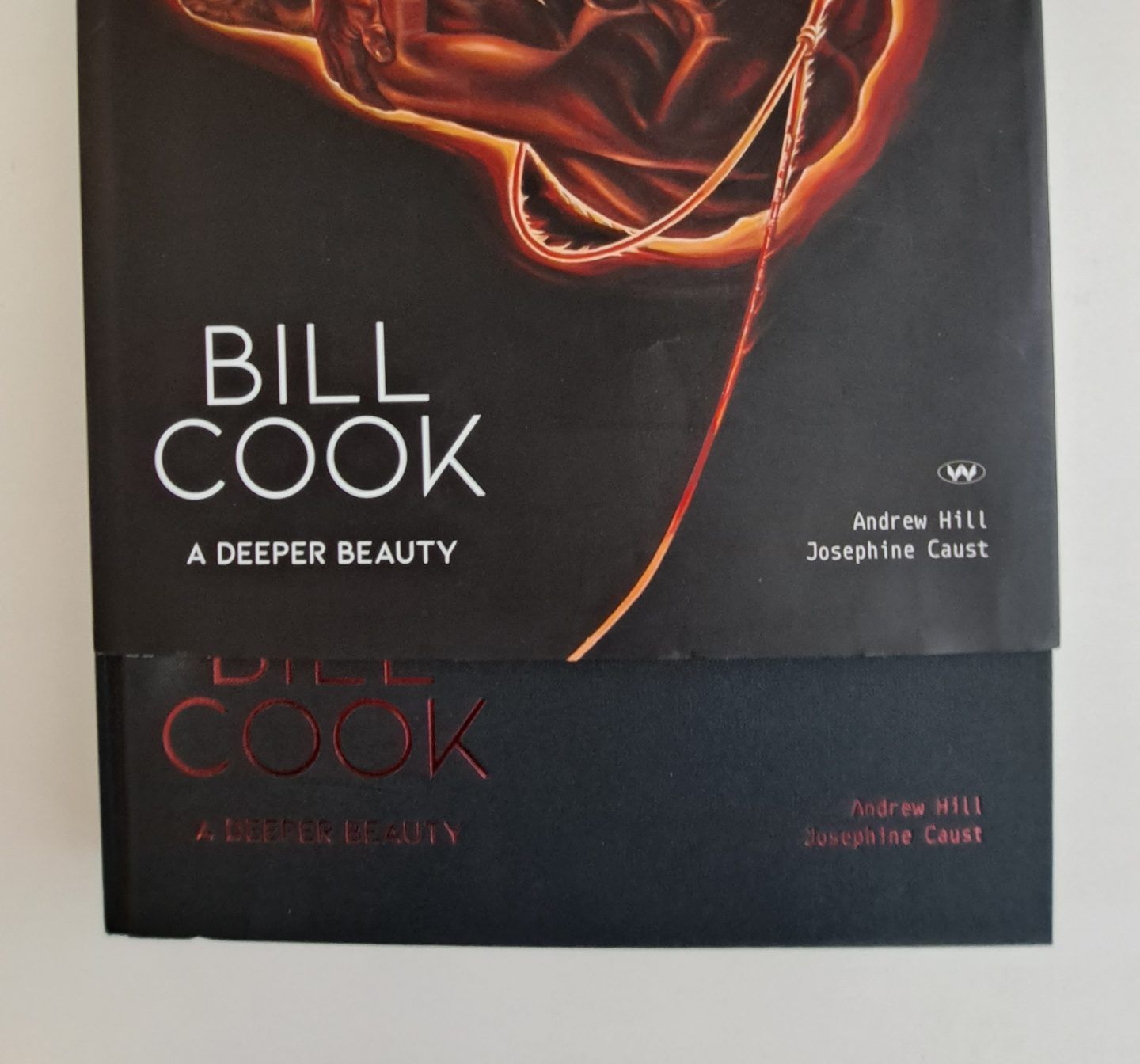
There are pros and cons to any book format. Casebound books have some great benefits over the other formats you could print your book in:
As with any book, casebound books do have their issues for readers and authors alike. It’s up to you to decide if the pros outweigh the cons:
Having a casebound version of a book is especially useful for publications that need to last a long time or have a high capacity for durability, but really any book can be casebound. It is very common for most genres of fiction and non-fiction to have a casebound version as traditional publishers release a casebound version of their books first to help maximise their profits.
If you are publishing your book traditionally, it’s likely that your book will have a casebound version as it is a standard procedure for these publishers. On the other hand, self-publishing authors need to be aware of the costs of printing casebound books and decided whether it is worth the cost (discussed a little later).
Otherwise, as a general rule, a book can be casebound if it has more than 30-80 pages. If your book doesn’t fit these specifications, check with your publisher or printer to see if your book is able to be casebound or have a think about other strategies, like making your book size smaller or adding more content.
As a general rule, paperback books sell more copies than casebound books. Paperback books are almost always cheaper for customers than their casebound counterpart and many readers prefer their lightweight nature. Casebound books, on the other hand, generally do not sell in as large of quantities, but they do generate higher returns on sale. This means that you don’t have to sell as many books to be profitable compared to paperback.
Many readers have their preferences for the kind of book format they like, and there are certainly a lot of them who will opt for a casebound book when given the decision.
The cost of any printing venture is highly personal and varies from project to project. This is because the cost of printing a book depends on many different variables, such as the quality of the print, the size of the book, and even the printer itself.
This includes embossing/debossing, foiling, spot-gloss, printed ends, and more. Applying one or more print finish will increase the cost of your book as it adds extra material and processes.


Certain types of binding are cheaper than others. Casebound books are more expensive than other binding types because the materials used in the production costs more to source. There are also additional processes undertaken by printers create casebound books.
The quality of the paper will dictate both how much the paper costs (higher quality = higher cost and vice versa), but it can also have an impact on freight costs as higher GSM paper is thicker and therefore weighs more.
Books with a smaller page count require less paper and are lighter, meaning they cost less both in the printing process and when it comes to freight.
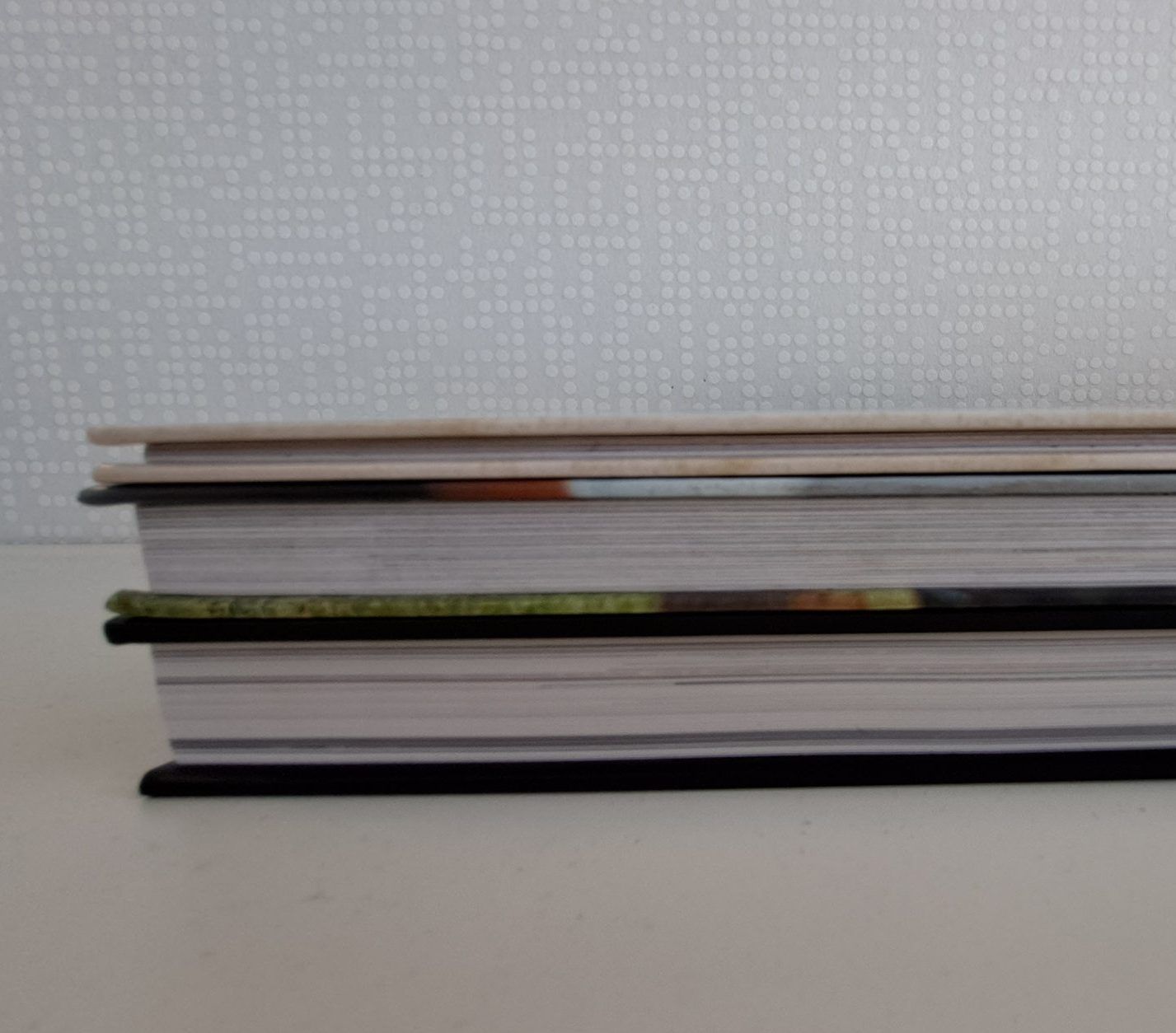
No two printers will give you identical quotes for a print run. This is because printers differ in factory (capacity) size, stock type and availability, and profit margins.
The location of a printer factors into the cost of printing for a few different reasons. Often, printing in countries like China will mean a cheaper price, but you’ll have to print in bulk and then pay for freight, which can also be quote costly. For our Australian authors, printing locally in Australia can cost more per book, but freight is often more affordable, and smaller print runs are available from most printers.
Organising a large (or bulk) print run will make the cost of printing a book cheaper per unit than they would be on a small print run. Choosing to print in bulk, however, means committing to a greater up-front cost.
The page you requested could not be found. Try refining your search, or use the navigation above to locate the post.
The page you requested could not be found. Try refining your search, or use the navigation above to locate the post.

Estimated reading time: 9 minutes
Nearly every publisher, no matter how big or small, has guidelines for manuscript submissions. Green Hill Publishing is no different. Read this blog and learn about our submission guidelines and how to use our templates.
Green Hill have developed submission guidelines to simplify the process of bringing your manuscript into our design software for typesetting. It ensures that we have the same understanding of your content as you do. Our designers can then focus more on the readability and design of the book. Having a submission guideline makes sure nothing gets lost in translation and can help cut down the need for design revisions, making the process smoother and often faster.
If you submit your manuscript without using our template and style guide, or if you have incorrectly used the template and style guide, we will flag this with you and give you a couple of options moving forward.
The first option is to allow you to reformat the manuscript and submit a new version to Green Hill. This gives you the chance to correct it yourself and ensure that everything is formatted in the way you are happy with.
The second option is for one of Green Hill’s Microsoft Word specialists to go through your manuscript and format it. This is done at an hourly rate and will be extra on top of your publishing package. It’s also good to note that, in the case of complex manuscripts (i.e. business books, textbooks, etc.), the specialist styling your manuscript may misinterpret headings etc in your book.
Of course, if you are having any trouble understanding the template, or you can’t work out what the most suitable option is for your book, contact us so we can guide you.
When you open the word template from your Green Hill Submission Guideline Documents folder, it will look mostly blank.

Firstly, what you’re going to do is to click “Enable Editing” in the banner up the top of document. This will allow you to make changes in the document. Then, you must get into the settings to set the document up properly to allow for the formatting. Go to “File” and click on “Options”.

This will bring up a pop-up. From there, go to “Advanced,” scroll down to “Cut, copy, paste,” and change “Pasting between documents” to “Merge Formatting” and click “OK.”

Now that the settings have been successfully altered, you need to open your manuscript document up in a separate window and copy and paste all of the text. If you’re comfortable with keyboard short-cuts, use Ctrl+A to highlight all of the text.
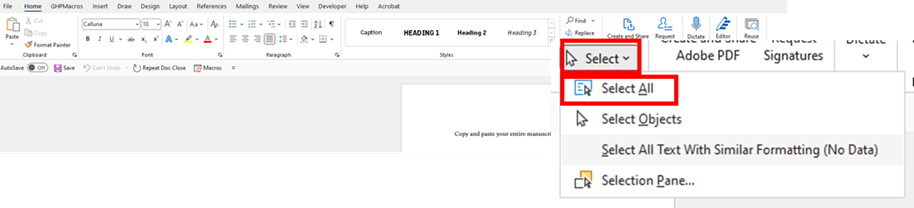
Alternatively, if you’re not comfortable with short-cuts, you can use the “Select All” button. First, go to the Home tab and find the “Select” dropdown. Then click on “Select All”.
If you’ve written your manuscript in multiple files, open them one at a time, select and copy all the text, and paste it into our word template in the correct order. It’s important to note the last part of those instructions as the team at Green Hill will assume you’ve ordered your manuscript correctly.
Next, you’ll need to open your styles pane. To do this, go to “Home,” and click the downwards arrow in the styles section. The Styles Plane will open to the right of the screen.

You’ll then need to ensure that you are only seeing the styles that we have recommended as Word has its own inbuilt styles that we don’t need. To do this, go to the style pane and click “Options,” then choose “Recommended” from the first dropdown menu and click “OK.”
Now it’s time to use the styles to format your manuscript!
For fiction authors, applying styles to your manuscript should be straightforward as you shouldn’t have too much differentiation of text in your manuscript. However, for authors with complex manuscripts like business books, some non-fiction books, textbooks, etc. the process of deciding which style to use can get a little tricky.
At the end of the day, it is okay if you choose the wrong style so long as you are CONSISTENT.
Keep a notepad next to you and write down what styles you’re using for particular elements of your text. This way, if you’ve chosen the wrong style, the team at Green Hill will be able to switch it out for a more appropriate one much easier.
If you’re not familiar with styles in Microsoft Word, don’t be daunted! We will go through how to use them step-by-step and if you still don’t quite understand, there is an instructional video you can watch.
Firstly, open up the Styles Guide document from your Green Hill Submission Guideline Documents folder. It’s a PDF which has a lot of information about how to set up your document for styling, how to use styles, and a styles A-Z. Right now, we’re interested in the Styles A-Z chapter, so skip down to there.
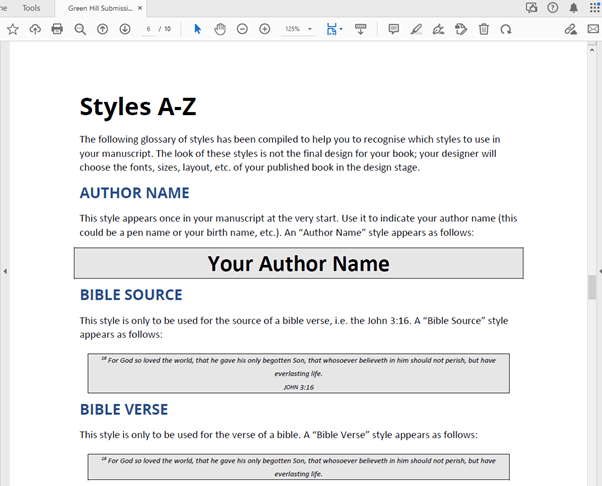
The Styles A-Z chapter runs through every style in your template and what it is typically used for. As your final design of your book won’t look like your formatted manuscript, don’t worry too much about the look of the styles. When deciding on a style, it’s always best to choose based on their described use.
When getting ready to use styles, it’s a good idea to either print out the Styles A-Z chapter or to have your screen split between these two documents. This is so that you can view both at the same time, allowing you to quickly reference the styles A-Z document while you format your manuscript.

Have a scroll through the different styles and make a note of which ones look appropriate for your manuscript. Once you’ve done that, it’s time to finally get formatting!
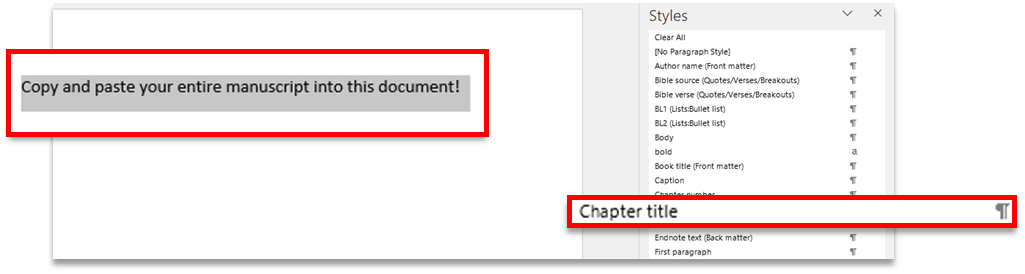
To apply a style, highlight the paragraph you want to change and then scroll through the styles pane until you find the appropriate style, then simply click on it. Go through the whole manuscript and do this for every paragraph.
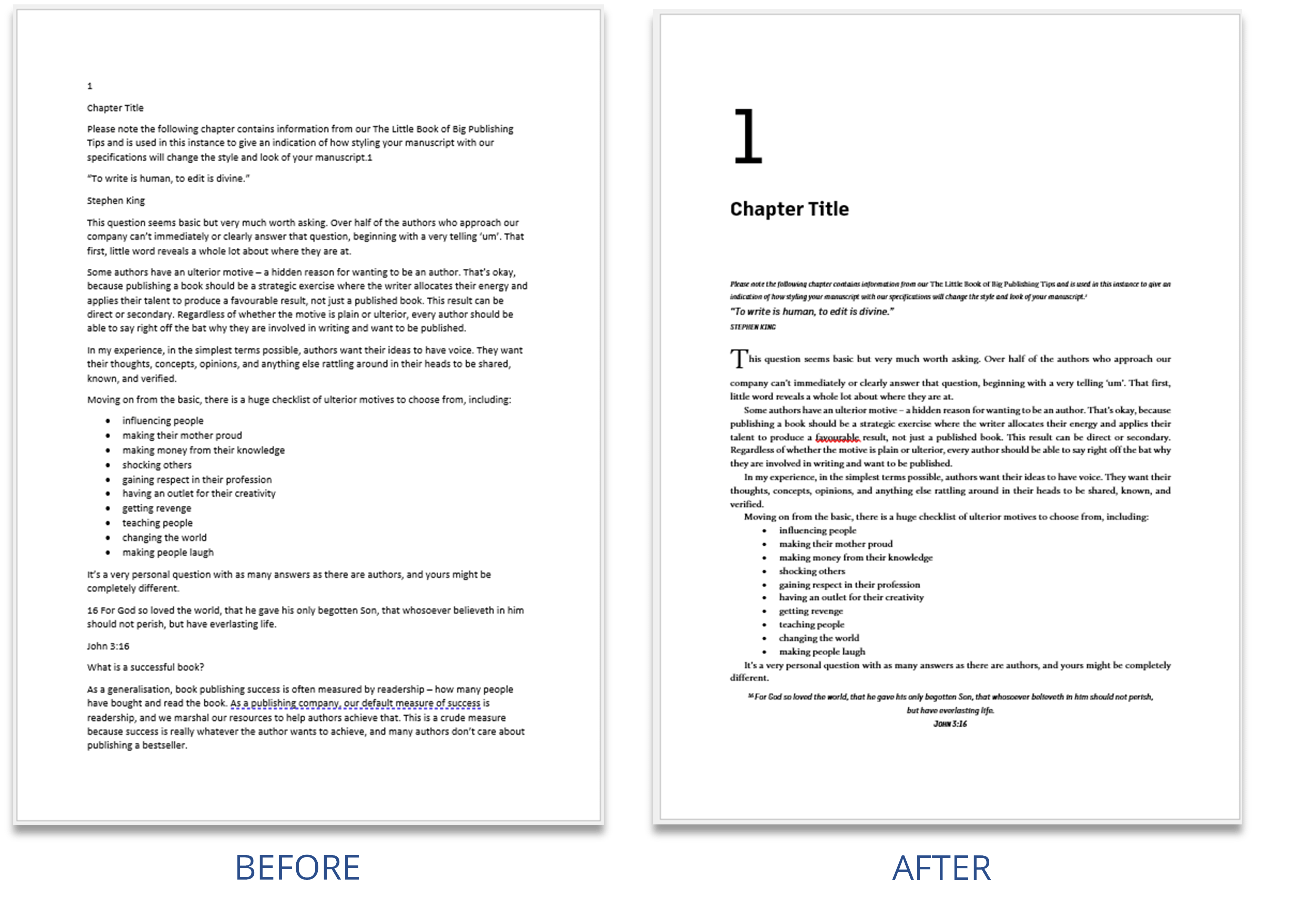
On our company website, we have a webpage dedicated to submitting your manuscript. It briefly details the steps that need to be undertaken and also features a helpful video tutorial that will walk you through the process.
You can find this webpage here: https://greenhillpublishing.com.au/submit-your-manuscript/
The page you requested could not be found. Try refining your search, or use the navigation above to locate the post.
The page you requested could not be found. Try refining your search, or use the navigation above to locate the post.